Hello everyone,
Over the easter weekend, I came across a tweet that Obsidian were looking for a new engineer to add to their team, and it was just their 4th engineer. This was insane, given how big their app is. This made me consider switching to Obsidian as my primary note-taking app (over Notion). However, I needed more to be convinced, and that is when I stumbled upon the file over app philosophy1 proposed by the CEO of Obsidian. What it says is the following:
- the files need to be independent of the app you use
- they need to stored with you, locally
- they need to be stored in a simple format such that 50 years from now, you can still access and read from it.
Obsidian believes in this and their whole system is built such that your files (and consequently your ideas) are with you, and will exist beyond the app. On the other hand, Notion stores the files in cloud, and moreover I don’t think it scales well in the long run as your interests might change and you would need to engineer a whole new organisation (come up with new folders and subfolders structure). With Obsidian, you can dump all the files into the same root directory and then use categories and topics to tag files according to their domain. You can then use these tags to navigate the files. This convinced me, and I made the switch :)
Now that I have setup and moved to Obsidian, I will have to wait and see if it all works out as expected! Another advantage with Obsidian was that I can integrate my note-taking and blogging into one system.
Blogging Setup with Obsidian and Hugo
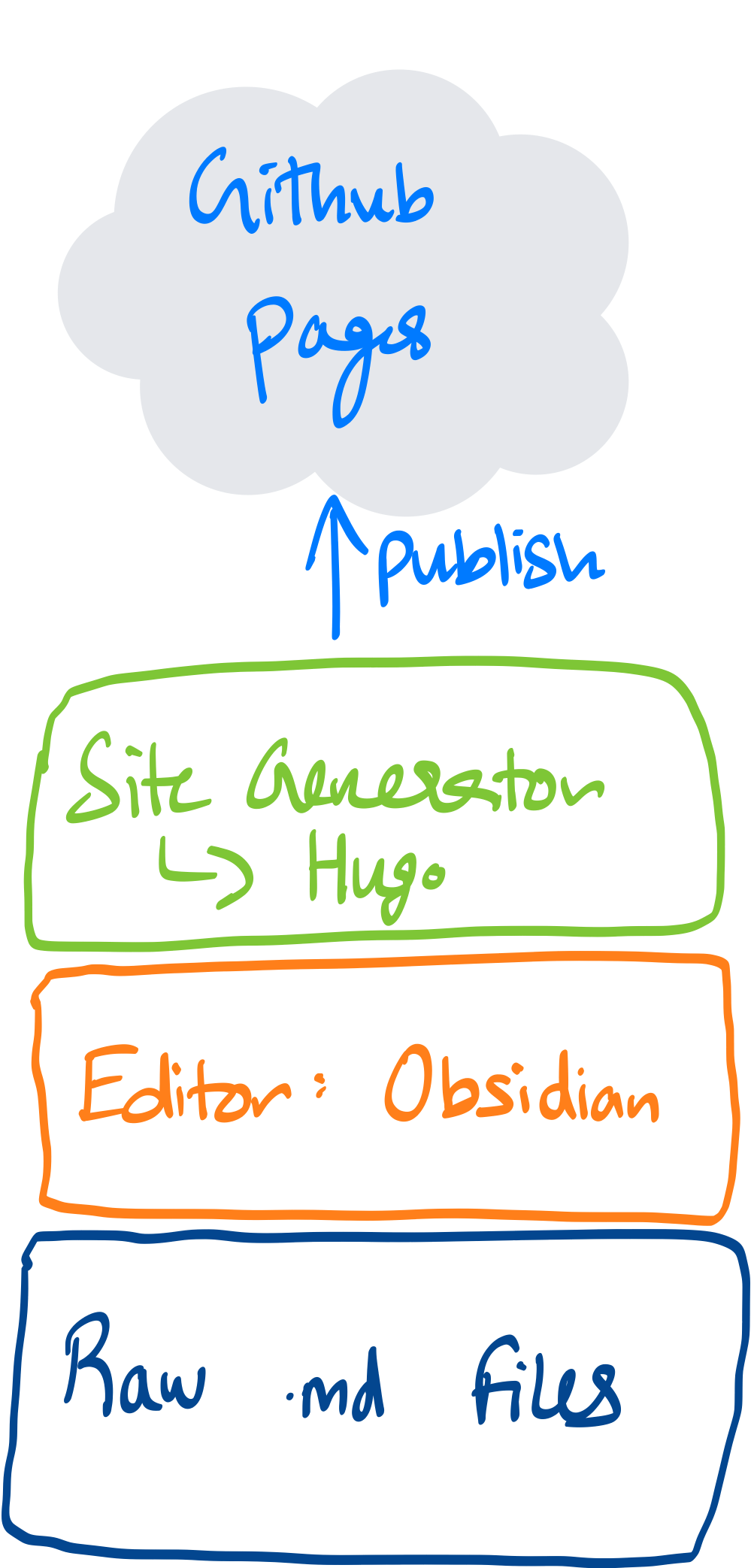
After setting up Obsidian, I wanted to integrate my blogging setup with it. I created a separate vault on Obsidian for my Blog, and I edit the files there. Once their ready, I push it to my github using Obsidian Git2. Finally, they are all rendered into a beautiful site using Hugo3 and published to github pages. I believe it is a simple, yet effective and free solution. The whole architecture is summarised below.
Challenges
While setting it up, I had challenges with image paths, as Obsidian and Hugo handled it differently. I circumvented that problem by using Page Bundles in Hugo, where the resources are stored along with the source index.md.
Best, Kaushik